
Unsorted Arrays vs Binary Search
What is Sorting?
A given list of numbers is said to be sorted if its elements are arranged in either ascending or descending order. By default, we usually consider ascending order unless stated otherwise.
For example:
- Unsorted array:
- Sorted in ascending order:
- Sorted in descending order:
Unsorted and Sorted Arrays
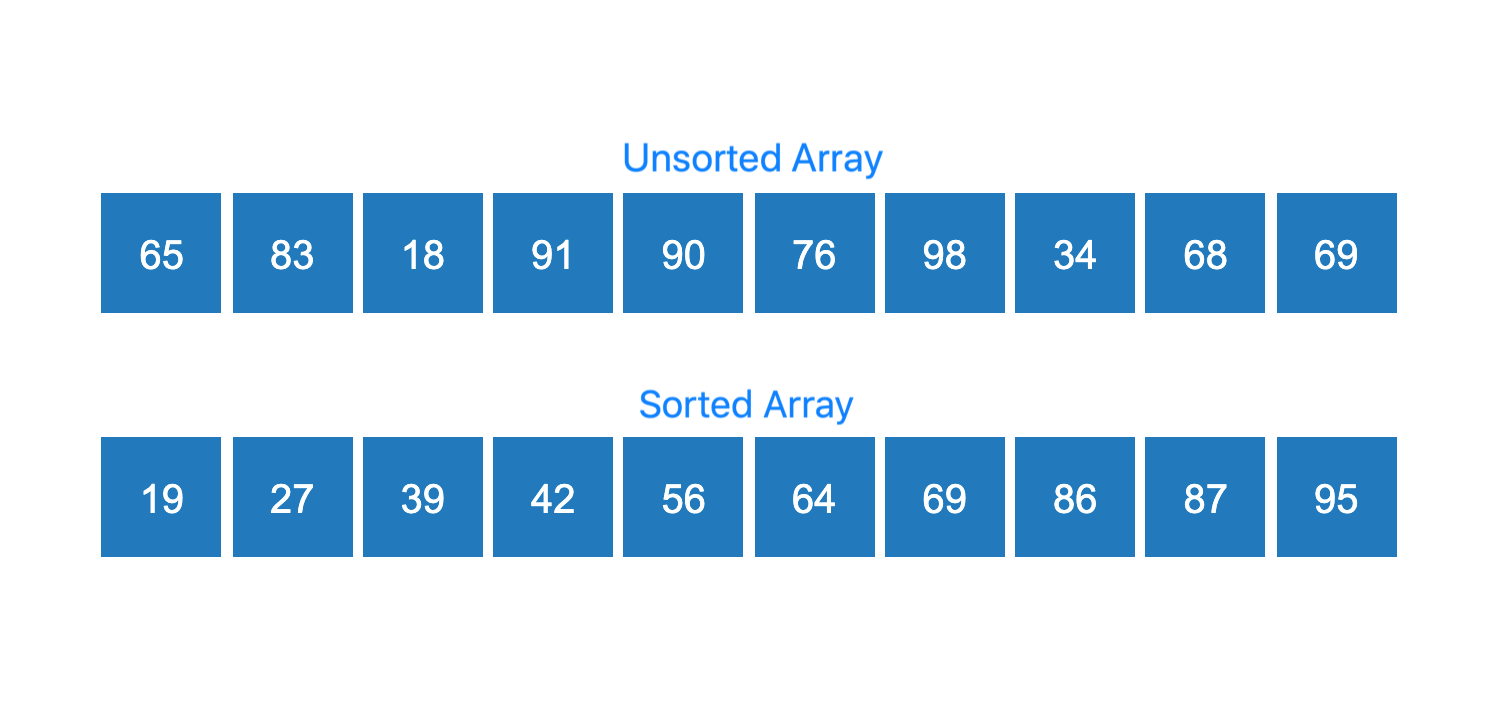
The ordering of an array is important because some algorithms can exploit this ordering to reduce the amount of work required.
Linear Search does not require the array to be sorted. Binary Search, on the other hand, requires the array to be sorted according to the ordering used by the search.
Time and Space Complexity
Time complexity describes how the running time or number of basic operations performed by an algorithm grows as a function of the input size.
Auxiliary space complexity describes the additional memory required by an algorithm apart from the memory used to store the input.
For an array containing elements, if an algorithm examines every element once, its time complexity is:
If an algorithm uses two nested loops and each loop may iterate times, the number of operations can grow proportionally to:
and its time complexity is:
In this experiment, we will use these ideas to understand why Linear Search has a worst-case time complexity of and why Binary Search has a worst-case time complexity of when applied to a sorted array.