
Unsorted Arrays vs Binary Search
Linear Search Algorithm
Observations
Linear Search compares the target element with the array elements sequentially.
The number of comparisons depends on the position of the target:
- If the target is found immediately, only one comparison may be required.
- If the target is near the end, many comparisons are required.
- If the target is absent, all elements may need to be examined.
Iteration-by-Iteration Visualization of Linear Search
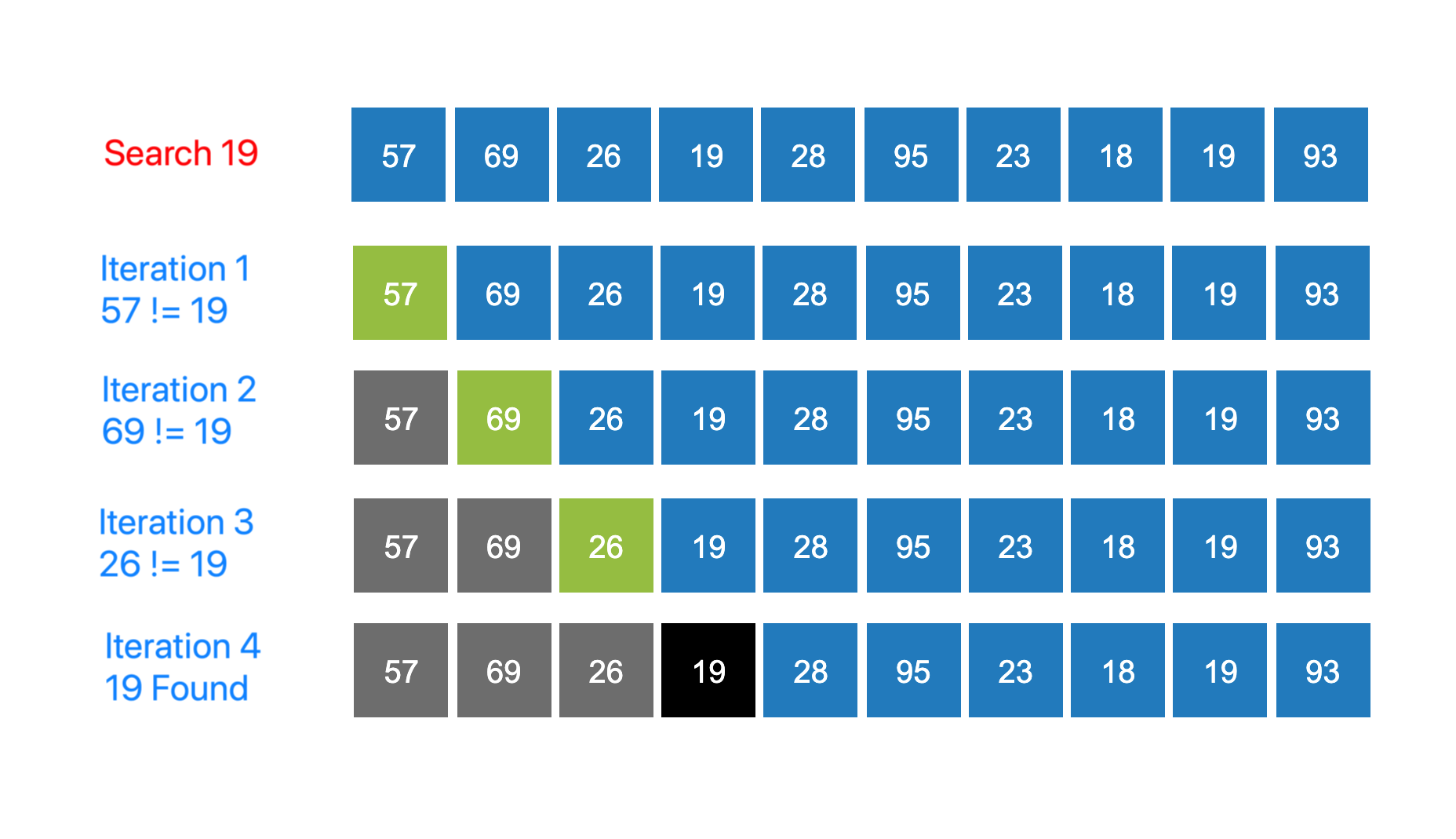
Linear Search Algorithm
Let's have a final look at the consolidated algorithm for searching for an element in an array of elements:
- STEP 1: Start from the leftmost element of the array and compare it with the query element.
- STEP 2: If the query element matches the current element, return its index.
- STEP 3: If the query element does not match the current element, move to the next element and repeat Step 2.
- STEP 4: If all elements have been examined without a match, report failure.
Complexity of Linear Search
For an array of elements:
- Best-case time complexity:
- Worst-case time complexity:
- Auxiliary space complexity for the iterative algorithm:
Linear Search is particularly useful when the array is unsorted and only a small number of searches are required, because no preprocessing or sorting is necessary.