
Unsorted Arrays vs Binary Search
Linear Search Concept
How Can We Search for an Element in an Array?
Linear Search is a straightforward searching technique in which the elements of an array are examined sequentially until the required element is found or all elements have been examined.
Suppose the array contains elements and the target element is .
The search proceeds as follows:
- Start from the first element of the array.
- Compare the current element with the target .
- If the elements match, report the index of the matched element.
- Otherwise, move to the next element.
- Continue until the target is found or the entire array has been examined.
Why Does Linear Search Work on an Unsorted Array?
Linear Search does not depend on the relative ordering of the elements.
For example, consider:
To search for , Linear Search can examine the elements one by one:
The target can be found even though the array is not sorted.
Therefore:
Linear Search can be directly applied to both sorted and unsorted arrays.
When Should We Stop?
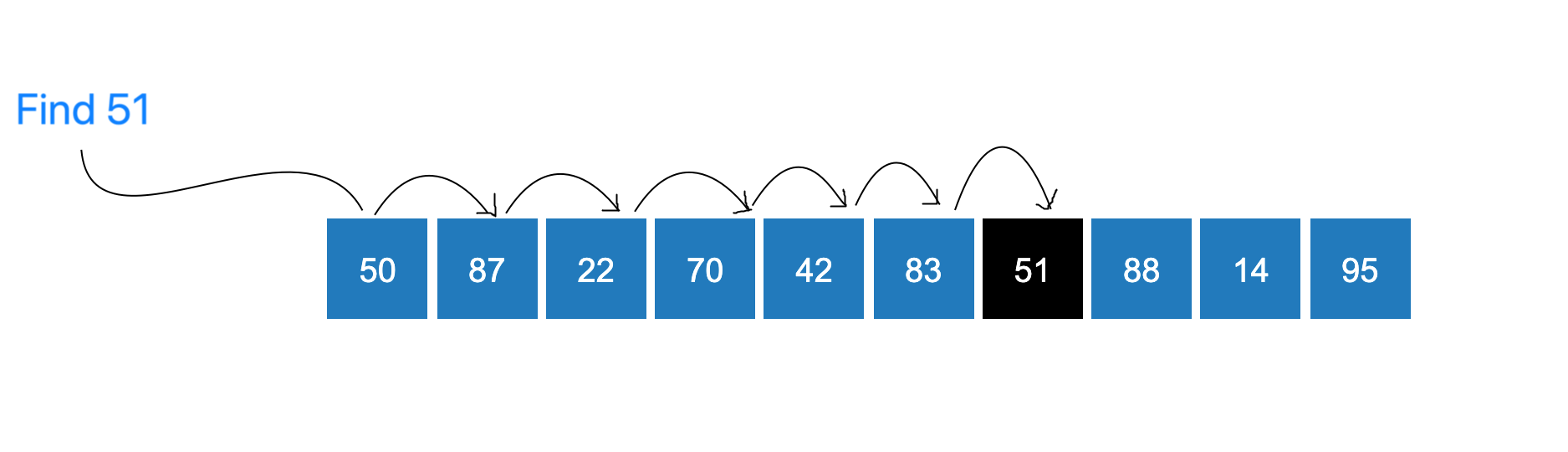
The search stops in either of the following situations:
- The target element is found.
- Every element has been examined and the target is not present.
If the target is found at index , the algorithm can return that index without examining the remaining elements.
If all elements are examined without finding the target, the algorithm reports failure.
Important Observations
A few important observations about Linear Search are:
- No ordering of the array elements is required.
- The algorithm examines elements sequentially.
- In the best case, the target is the first element examined, so the search takes time.
- In the worst case, the target is the last element or is not present, so all elements may need to be examined. Therefore, the worst-case time complexity is .
- An iterative Linear Search requires only a constant amount of auxiliary memory, giving an auxiliary space complexity of .
Step-by-Step Process for Searching an Element
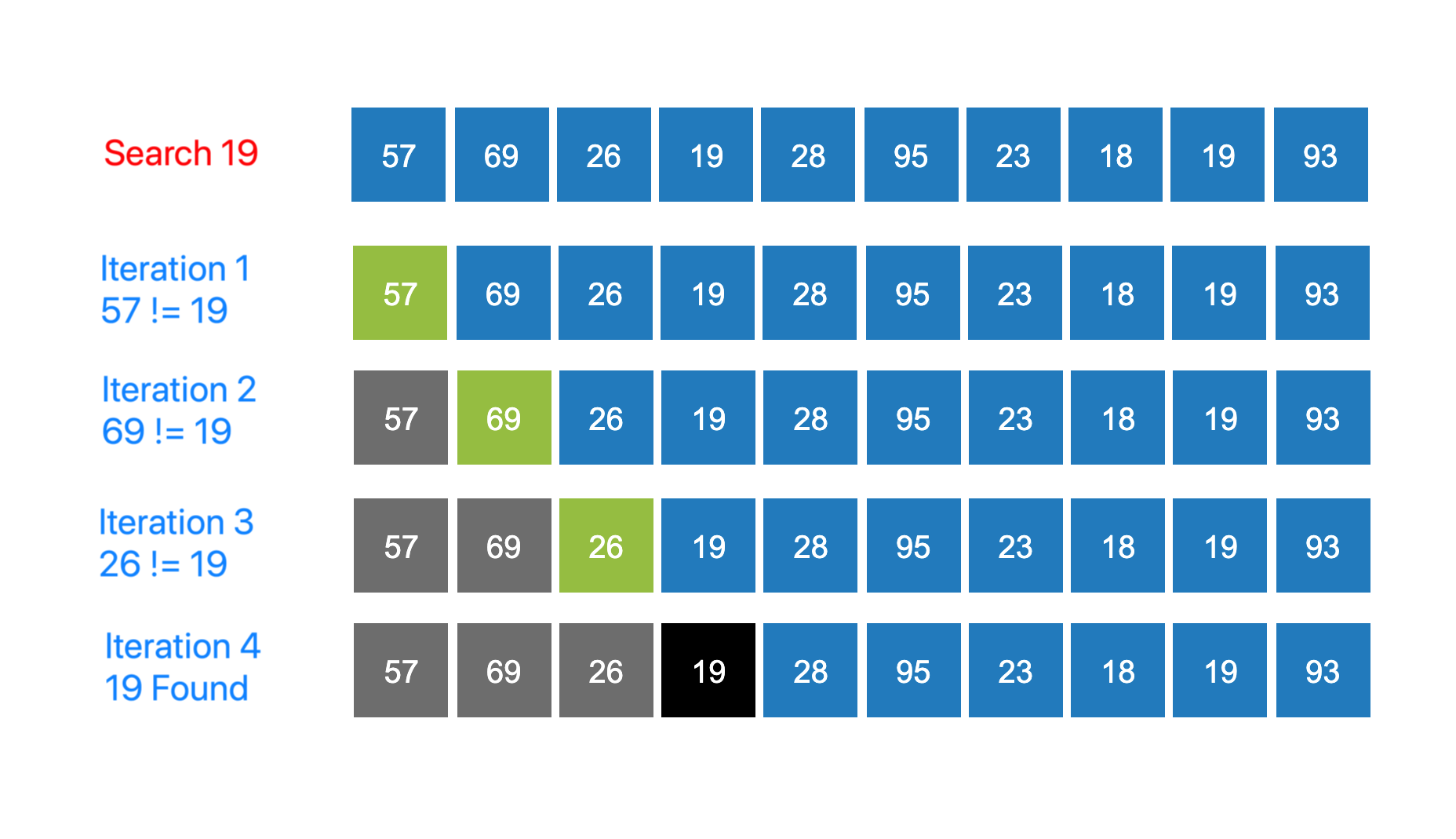
The step-by-step process demonstrates how the search proceeds from one element to the next until a match is found or the array is exhausted.